"Make Your Groove Happen!" |
 |
||||||||||||
“He was my idol. That stuttering kind of bass line, bouncing all around the beat but keeping it right in the groove- well, they don’t call Jerry the Groovemaster for nothing. He’s the best” Jaco Pastorius |
|||||||||||||
BASSIST  EDUCATORSONGWRITERCOMPOSERINVENTOR EDUCATORSONGWRITERCOMPOSERINVENTOR |
|||||||||||||
|
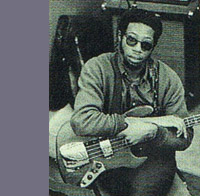
Born in the Bronx, New York in 1946, this two time Grammy Award-wining bassist was one of the pre-eminent session bassists of the late 1960s and early 1970s, working with an impressive cross section of the era's finest soul, jazz and blues artists. One of the youngest of the many Jazz musicians to come out the Bronx during the 1950s, Jerry Jemmott found his way to prominence on acoustic bass with Pucho & The Latin Soul Brothers and the Mercer Ellington Orchestra. He switched to electric bass in 1964 and shaped his skills to eventually join many of his heroes in the recording studios of New York City. He played on and arranged his first major recording sessions with JJ Jackson and played on Nina Simone's 'The Blues' album in 1965. He got his big break when he was discovered by Rhythm 'n Blues/Jazz saxophonist King Curtis, and thanks to his Atlantic Records connection through Curtis he subsequently became a key architect of the Atlantic Records and Muscle Shoals Sound. Jerry has been a performer since the age of five, starting as a tap dancer with Mary Bruce’s Star Buds, in Harlem, where he performed at Carnegie Hall in their annual review. He stands on the shoulders of the many musical geniuses of his time but owes his love of the bass to bassist Paul Chambers, whose rhythmic pulse and note selection captivated him and Charles Mingus who's harmonic propulsion and writing skills continue to motivated him. His mother Jessie insisted that he take lessons and after one year of upright bass lessons with Felix Mann, he started working professionally at the age of twelve in the many bars, night clubs and ballrooms in New York City with different bands, 3 to 4 nights a week, always learning more and often teaching, as he went along. His body of work illuminates the times both then and now as he played on the recording of Ain't Got No/ I Got Life” w/ Nina Simone, “The Revolution Will Not Be Televised” w/Gill Scott Heron, “People Got To Be Free” w/The Rascals, “The Universal Prisoner” w/ Les McCann & Eddie Harris, “Think” & “Eleanor Rigby ”w/ Aretha Franklin, “Attica Blues” w/ Archie Shepp, “Why I Sing The Blues” & “The Thrill Is Gone” w/BB KIng plus a recent cameo solo performance in the film “Mitchellville”. B.B. KING says: “He never does anything just because it’s right to do; he likes to do it because it feels good doing it. He would come up with things that fit…Quincy Jones has a way of working with people where he’ll get them together and say ‘Okay, get into something. Jerry was the same way….Jerry was very concerned.” * *Excerpt reprinted from Bass Player Magazine |
||||||||||||
| website designed and maintained by Geoff Rosenberg, Bassboy Productions |